Luxury Real Estate Photography: The Complete Photographer’s Guide (2026)
Luxury real estate photography is the specialized practice of shooting high-end residential properties (typically priced at $1M+, with most work in the $2M-$25M range) for marketing, listing, and editorial use. It uses full-frame or medium-format cameras, tilt-shift lenses, multi-flash interior lighting, drone aerial work, and intensive post-processing to render scale, materials, and atmosphere that standard MLS photography cannot.
That definition is the easy part. The hard part is moving from $200 standard listing shoots to $1,500 luxury commissions, and that move requires more than a better camera. It requires a different workflow, a different visual language, and a different conversation with the listing agent. This guide is built for working real estate photographers who want to move upmarket. If you’re already shooting MLS standard work and you want to land your first $5M estate, keep reading.
What Makes Luxury Real Estate Photography Different
Standard real estate photography sells a house. Luxury real estate photography sells a lifestyle, a location, and a story. The buyer for a $4M coastal estate isn’t comparing square footage on Zillow. They’re being courted by a listing agent who needs the property to feel like the only one in its category.
The work breaks from MLS standards in four concrete ways. First, the time on site is longer: a typical luxury shoot runs four to eight hours per property, sometimes split across two days for twilight coverage. Second, the file count is higher because luxury listings live on dedicated property websites, print brochures, social campaigns, and broker tour decks, not just the MLS. Third, the post-processing budget is significant: window pulls, vertical correction, sky replacement, fixture relamping, and clean composite blending all show up in nearly every frame. Fourth, the client relationship is a partnership rather than a transaction, which changes how you quote, schedule, and deliver.
The luxury market itself is shifting in 2026 in ways that favor specialists. According to NAR’s 2026 forecast, existing-home sales are projected to rise about 14% next year and home prices are forecast to climb 4%, with a market increasingly split between cash-rich, equity-driven move-up buyers and a record-low share of first-time buyers. That split puts more dollars at the top of the market, and listing agents working those transactions need photography that justifies the price point.
Equipment for Luxury Real Estate Shoots
You can shoot a $500K tract home on an APS-C body and a kit zoom. You cannot shoot a $6M estate that way and still book repeat work from the listing agent. Luxury work demands resolution, dynamic range, perspective control, and clean ambient-plus-flash workflows. Below is the kit we suggest for photographers moving into this tier, with notes on why each piece matters. For a complete breakdown of camera bodies, supports, and accessories across price tiers, see our full real estate photography equipment guide.
Camera Bodies: Why Full-Frame or Medium Format Matters
Sensor size drives three things that matter for luxury interiors: dynamic range, depth-of-field control, and the resolution headroom you need for print brochures, double-truck magazine spreads, and 60-inch broker tour displays. A full-frame body with 45-61 megapixels is the practical minimum at this tier.
The Sony A7R V sits at the center of this category. It pairs a 61-megapixel back-illuminated full-frame sensor with 15 stops of dynamic range, an AI-driven autofocus system using 693 phase-detection points, and 8-stop in-body image stabilization, making it one of the most capable tools available for luxury interior work. Two features matter specifically for luxury interiors: focus bracketing, which captures up to 299 frames at sequentially shifted focus points for front-to-back sharpness compositing, and Pixel Shift Multi Shooting, which combines multiple sub-pixel-shifted exposures into a single image with detail well past native resolution. For a marble foyer or a millwork-heavy library, that resolution is real money on the wall.
Canon and Nikon compete directly here. The Canon EOS R5 (45MP) and the Nikon Z8 (45.7MP) are both excellent. Medium format (Fujifilm GFX 100 II, Hasselblad X2D 100C) makes sense once you’re shooting $10M+ properties regularly, where the larger sensor’s tonal rolloff in marble, polished wood, and high-end fabric becomes visible to art directors. Below that tier, full-frame is the working standard.
Lenses: Tilt-Shift and Ultra-Wide
One lens choice separates real estate photographers from luxury real estate photographers: a tilt-shift. A 17mm or 24mm TS-E (Canon) or PC-E (Nikon) lets you keep verticals plumb without correcting in post, which preserves resolution and stops the architectural distortion that ruins shots of formal entries, grand staircases, and tall living rooms. Tilt-shift lenses also enable multi-row stitching for ultra-high-resolution interiors, which is how you get magazine-grade frames of double-height great rooms.
Around the tilt-shift, build a kit with a fast ultra-wide zoom (16-35mm f/2.8 or 14-24mm f/2.8) for tight rooms and architectural details, a 24-70mm f/2.8 for vignettes and detail shots, and a 70-200mm f/2.8 for compressed exterior shots, landscape framing, and tight architectural details from across an estate. For exteriors at distance, a 100-400mm zoom is useful on properties with long approach drives or coastline frontage.
Lighting: Flashes, Modifiers, and Light Painting
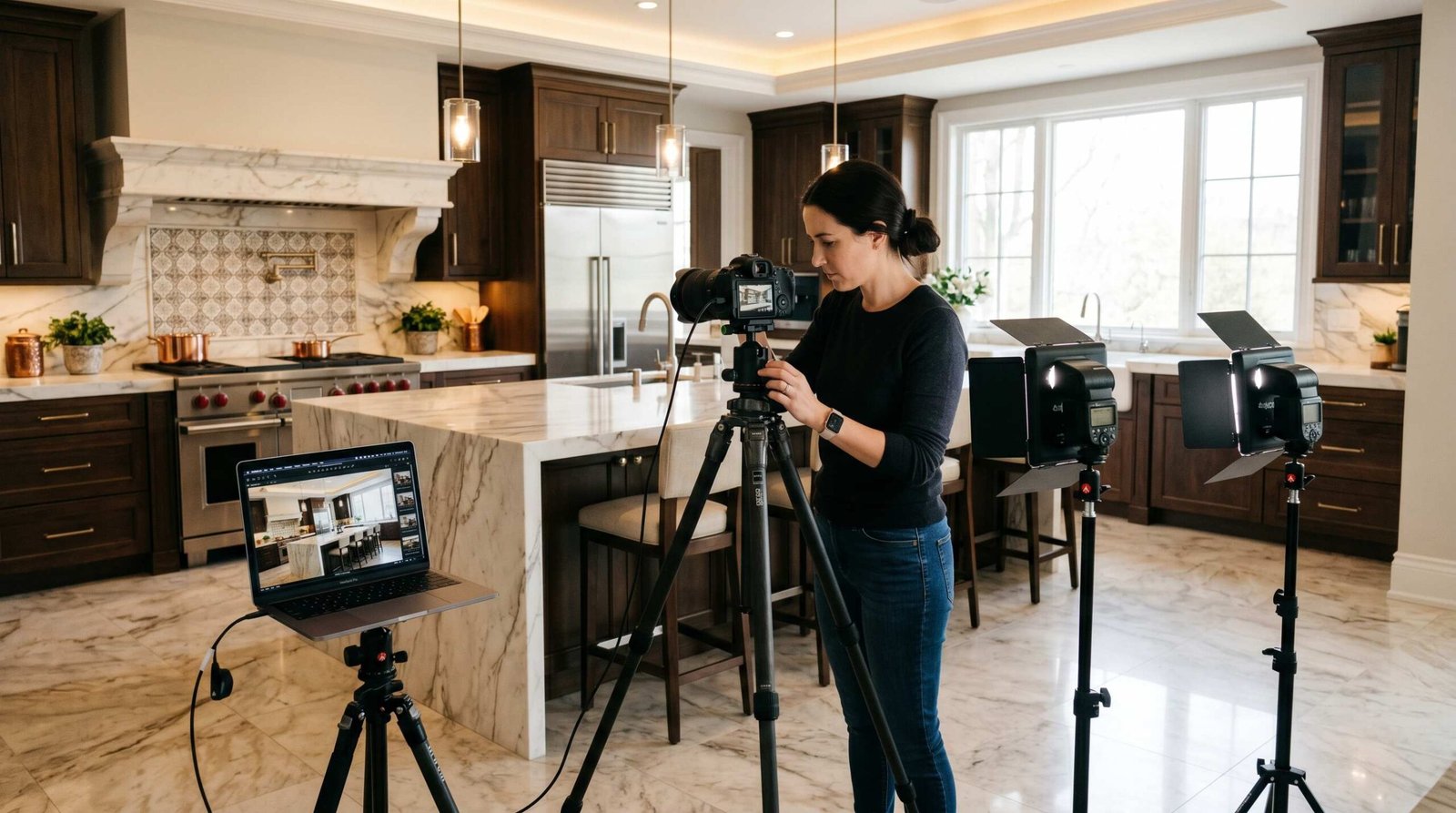
Luxury interiors are a flash game. Single-exposure HDR works for MLS, but it cannot match the controlled look of properly flashed work in a room with mixed daylight, tungsten chandeliers, LED accent strips, and reflective marble. Plan for four to six speedlights minimum, with a couple of higher-output strobes (Godox AD600, Profoto B10X) for larger rooms, two-story foyers, and any space with serious cubic volume.
Modifiers matter more than wattage at this tier. Bounce umbrellas, large shoot-through diffusion panels, and gridded softboxes for accent work let you separate the ceiling plane from the wall plane and add directional pop to artwork, sculpture, and built-ins without flattening the room. Bring CTO and minus-green gels for matching practical fixtures. A small reflector kit cleans up shadow side detail on furniture and finishes.
Light painting (long exposures with a handheld continuous light) is still useful for wine cellars, theater rooms, gym spaces, and dark wood libraries where flash bounce gets ugly. It’s slower but the results look painted rather than lit.
Drone: Why Almost Every Luxury Shoot Includes One
For luxury listings, aerial coverage isn’t a bonus, it’s table stakes. Estate context (how the home sits on the lot, the relationship to water, the scale of grounds and outbuildings) cannot be communicated from ground level. A DJI Mavic 3 Pro or DJI Air 3 is the working baseline for most photographers entering luxury work. The Mavic 3 Pro’s Hasselblad camera and triple-lens system gives you wide context, mid telephoto for compressed lot shots, and tighter perspective for facade details, all from a single aircraft.
You will need an FAA Part 107 commercial license to fly drones for paid real estate work in the United States. Some luxury markets (coastal areas, gated mountain communities, properties near major airports) also require LAANC airspace authorization or specific waivers. Build that into your schedule because lining up authorization on a property with a controlled-airspace overlay can take hours.
Core Techniques for Luxury Listings
Equipment is the floor, not the ceiling. The techniques below are where the visual difference between MLS work and luxury work actually lives. For broader shoot-day technique fundamentals that apply across the spectrum, our real estate photography tips guide covers the on-site basics. The notes here are specific to luxury work.
Composition at Scale: Larger Rooms, Grand Architecture
Big rooms break standard real estate composition. A 24mm framing that works in a 12×14 bedroom looks empty in a 30×40 great room. Three composition shifts solve this.
First, move your camera position farther from the corner than you would in a typical room. Standard interior shots pull tight to the corner to maximize perceived volume. Luxury rooms already have volume, so pulling tight collapses the architecture. Pull back, frame the architecture as the subject, and let the furniture support the space rather than fill it.
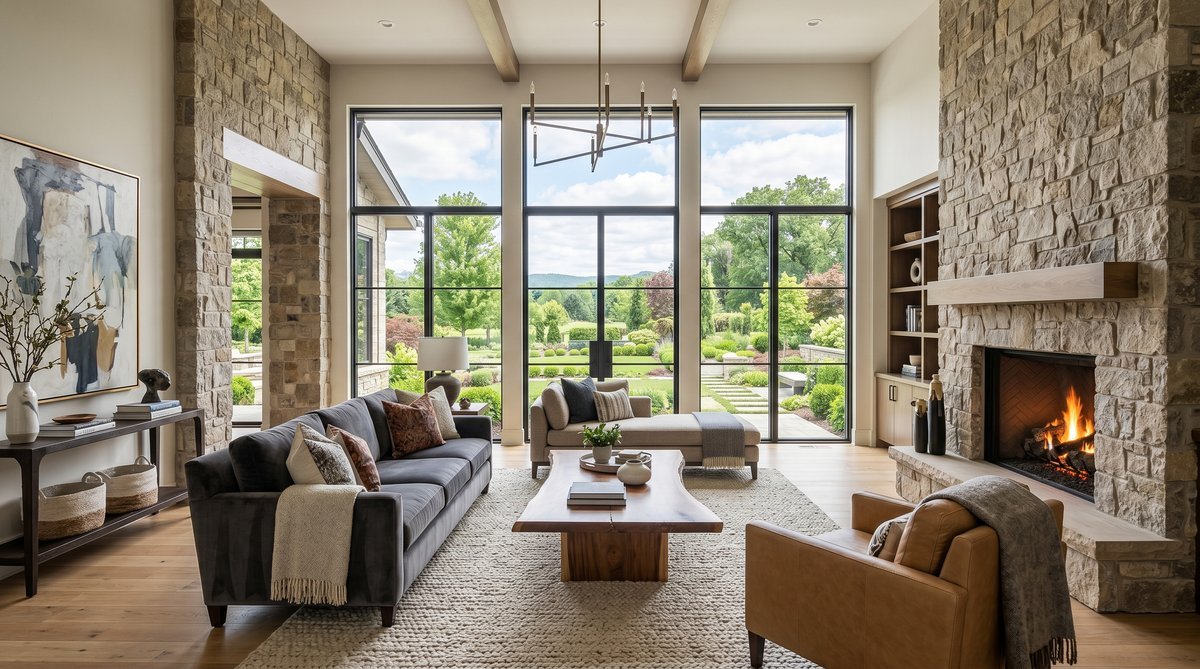
Second, find the architectural anchor in each room. A coffered ceiling, a stone fireplace, a span of windows, a built-in wall of millwork. Compose to feature it, not to centerline it. Off-center compositions read more editorial than the symmetric MLS straight-on look.
Third, use vignette shots aggressively. A great luxury set isn’t 30 wide-angle room shots. It’s eight to twelve heroes and twenty to thirty vignettes (a hand-laid herringbone floor, a detail of the chef’s-grade range, a tight shot of a Carrara waterfall counter). Vignettes are also what brokers feature in social media reels and email blasts, so they earn their place in the deliverable.
Natural vs. Created Light
Pure natural light is fast but rarely flatters luxury interiors. The reason is mixed sources: floor-to-ceiling windows dump cool daylight at one color temperature while interior chandeliers, recessed cans, and sconces fire warm. A natural-light exposure flattens that contrast.
The luxury standard is ambient base plus controlled flash, blended in post. Set your base exposure for window detail and warm interior lights, then add bounce flash to fill the shadow side of furniture and architecture. Keep practical fixtures on at full output so the room reads as lived-in rather than studio-lit. The mark of a good flashed luxury frame is that no one notices the flash.
Twilight and Blue-Hour Shots
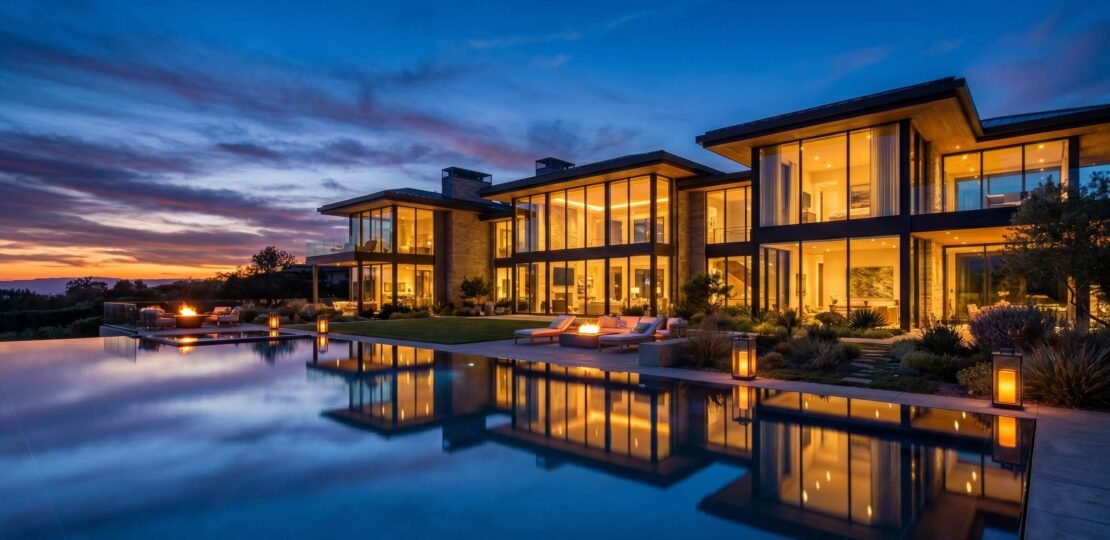
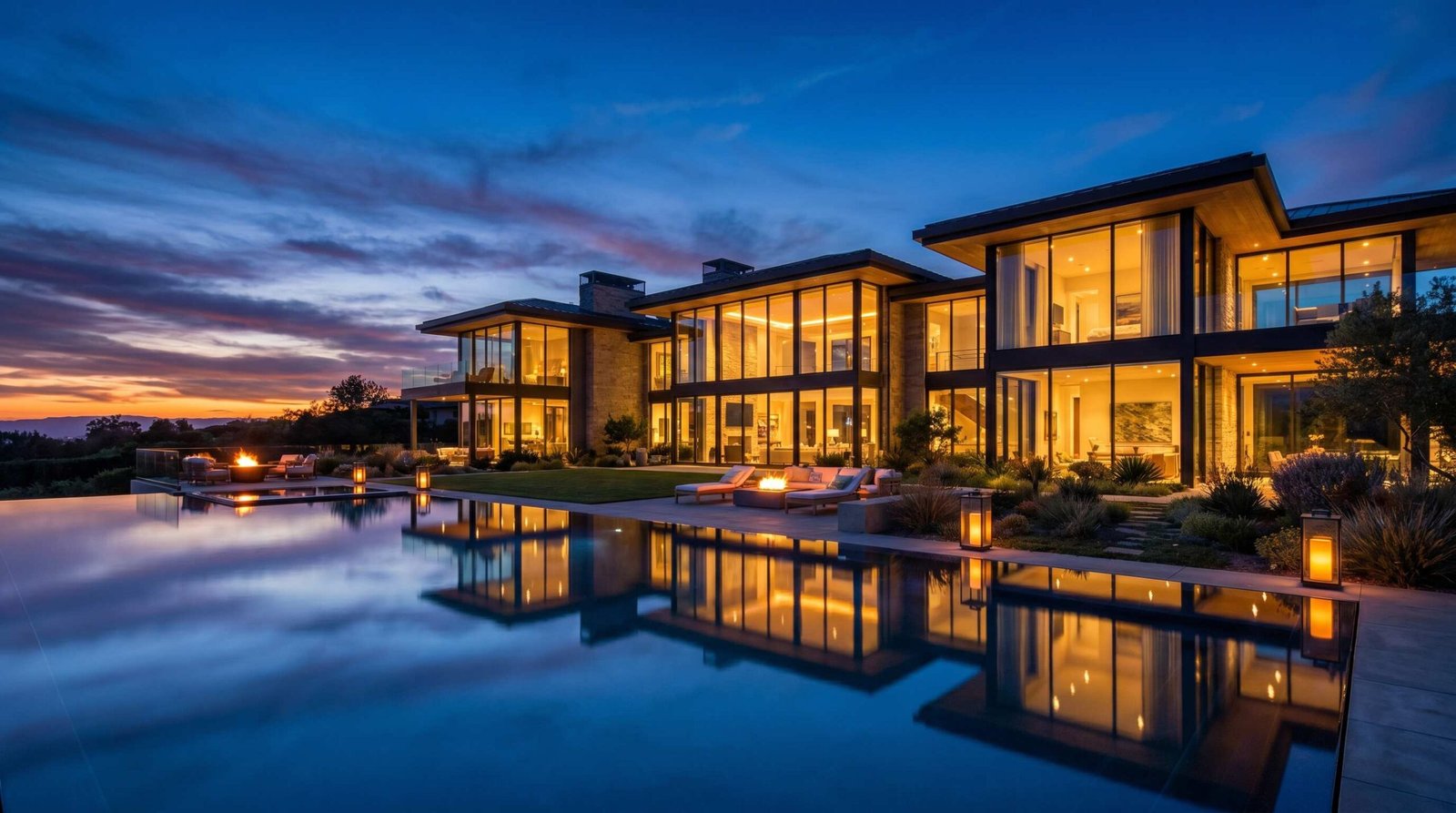
Twilight imagery is the hero frame for nearly every luxury listing. It does three things ground-level daylight cannot: it pulls warm interior light to the foreground, it renders the sky in deep saturated blue, and it hides anything ugly (a neighbor’s roofline, a power pole, a flat lawn) under low ambient. The result is a frame that reads like a high-end hospitality ad rather than a real estate listing.
The window is short, roughly 20 to 35 minutes after sunset depending on latitude and weather, so plan the property walkthrough so every interior light is on, every drape is pulled correctly, and your tripod position is locked before the sky starts shifting. Bracketed exposures (a base sky exposure, mid exposures for facade and pool detail, and longer exposures for interior glow) blend into a final composite that looks impossible because it is: no single moment in real life held all those values. Our dedicated twilight real estate photography guide walks through bracketing sequences, sky-detail capture, and exposure timing in more detail.
Drone and Aerial Work
Drone footage for luxury is not a single overhead “Google Maps” shot. Plan three altitudes per property. Low (40 to 80 feet) for landscape-style hero frames that show the home in its setting at human scale. Mid (150 to 200 feet) for traditional aerial context. High (300 to 400 feet) for showing the property in its larger geographic story (proximity to water, mountains, vineyards, conservation land).
Capture twilight aerials when conditions allow. A blue-hour aerial with pool lights, landscape lighting, and warm interior glow visible from the air is one of the single most effective frames you can deliver on an estate listing. Verify in advance that local regulations permit twilight commercial drone flight in that airspace because waiver requirements vary.
Pre-Shoot Planning for Luxury Properties
The single largest difference between standard and luxury real estate photographers is preparation. On a $400K listing, you arrive, walk through, shoot. On a $5M estate, you do that drive a week before the shoot with the listing agent.
Your scouting walkthrough establishes four things. Sun direction at each major exterior face throughout the day so you can sequence the shoot to catch the right light on the right elevation. Interior staging gaps (rooms that need furniture moved, art rotated, kitchen counters cleared, towels swapped, fresh flowers added). Switching plan: which lamp circuits and chandeliers need to be on during the daylight shoot and which need to come on for twilight. Logistics: where you park, where you can stage gear, who unlocks what, and whether housekeeping or owners will be on site.
Coordinate directly with the staging professional if there is one. Stagers think in terms of buyer psychology and seasonal styling. You think in terms of focal length, camera height, and what reads on a 14mm frame. A 30-minute conversation in advance covers shot-by-shot styling adjustments (a single throw pillow swapped, a cluster of objects moved off a console, a rug rolled to expose a hardwood inlay) that would otherwise eat an hour on shoot day.
Build a written shot list and share it with the listing agent and the homeowner 72 hours before shoot day. The list should call out hero frames, vignettes, exterior elevations, twilight position, and drone coverage. It manages expectations and lets the homeowner do the small prep work (clearing the master closet, hiding pet bowls, parking cars off the motor court) before you arrive. Plan for four to eight hours on site for the daylight portion, plus a separate twilight window if the property warrants one.
Pricing Your Luxury Real Estate Photography Services
Luxury pricing is not a multiplier on standard rates. It’s a separate pricing structure based on shoot complexity, deliverable scope, and the use case (single MLS listing vs. brokerage marketing vs. developer campaign). The table below is a working framework based on current market rates for independent photographers serving the $1M-$25M segment in mid-tier metro markets. Top-tier markets (NYC, Beverly Hills, Aspen, Miami coastal) run 30 to 80% higher.
| Shoot Type | Property Size / Tier | Typical Price Range | What’s Included |
|---|---|---|---|
| Base luxury listing | 3,000-5,000 sqft, $1M-$2.5M | $650-$1,200 | 30-45 final interior/exterior frames, single daylight shoot, standard post |
| Estate package | 5,000-12,000 sqft, $2.5M-$8M | $1,500-$3,500 | 50-80 final frames, full day on site, advanced post (sky replace, light fixture relamping, full vertical correction) |
| Mansion / compound | 12,000+ sqft, $8M+ | $3,500-$8,000+ | 100+ frames, multi-day shoot, dedicated post-processing schedule, broker tour edits |
| Aerial / drone add-on | Any luxury tier | $350-$900 | 15-25 final aerial frames, multi-altitude coverage, optional 4K video clips |
| Twilight add-on | Any luxury tier | $400-$1,200 | 5-10 twilight composites, separate evening session, advanced blending |
| Video walkthrough | Any luxury tier | $1,200-$5,000 | 2-4 minute edited piece, gimbal interiors, drone exteriors, licensed music |
| Property website / branded gallery | Any luxury tier | $200-$600 | Hosted single-property site with photos, video, virtual tour, and floor plans |
A few pricing principles to bake into every quote. Charge for total job value, not hourly time, because luxury clients respond poorly to hourly meters and your post-processing is a significant unbilled hour cost otherwise. Quote in packages with clear inclusions and clear add-ons so the agent can upsell the seller without renegotiating with you. Include usage and licensing language in your contract that limits frames to the listing and marketing of that specific property unless the broker or developer is paying for broader rights. The American Society of Media Photographers provides commercial photography business resources, copyright education, and licensing frameworks that are useful for structuring luxury contracts properly.
Building Your Luxury Portfolio (Even Without Luxury Clients Yet)
The chicken-and-egg problem in luxury work is real. Listing agents at the top of the market hire from referrals and from portfolios that already show luxury work. You won’t get hired without a portfolio, and you can’t build a portfolio without getting hired. There are three working paths around this. Read our guide on becoming a real estate photographer for the broader career foundation, then layer the luxury-specific moves below on top.
Path one: shoot for free or at cost on the right properties. Find a builder or designer working at the luxury tier and offer to shoot their model home or recent custom build at no charge in exchange for a usage license and credit. The work goes in your portfolio with the address and property details, the builder gets professional marketing assets, and the next listing agent who sees your portfolio cannot tell whether you were paid market rate or zero. Pick the property carefully: a 6,000-square-foot custom in a desirable submarket beats a 12,000-square-foot project in a market no one knows.
Path two: target boutique listing agents at brokerages where the average price is creeping into the bottom of the luxury tier. The $900K-$1.5M segment is where photographers earn their first luxury credits because the agents working it are climbing the same ladder you are. Charge a fair luxury package rate for that tier and deliver work that overdelivers visibly. Three or four of those shoots, done right, gives you a portfolio that earns the conversation with a top-tier listing agent.
Path three: shoot architectural personal work. If you have a relationship with an architect, an interior designer, or a landscape architect, propose a portfolio collaboration on a recently completed private residence. The homeowner doesn’t need to be selling. The frames go in your portfolio as architectural work, and they read identically to luxury listing photography in the eyes of a listing agent reviewing your site.
However you build it, structure the portfolio as separate sections by tier and property type. A luxury listing agent doesn’t want to scroll through 60 mid-market kitchens to find your one waterfront estate. Lead with your strongest five properties. Show full property sets (15 to 20 frames per home) rather than single hero images, because a good single frame is luck and a good full set is skill.
Marketing to Luxury Real Estate Agents
Luxury listing agents are a small, networked, referral-heavy market. They don’t find you through Google. They find you through other agents, through their broker’s preferred-vendor list, through staging professionals, and through brand presence in places they already pay attention. Your marketing has to live where they live.
Direct outreach works when it’s specific. A cold email to “the top luxury agent in Naples” is noise. An email to a specific agent referencing a specific recent listing of theirs, with a one-paragraph note on a frame you would have shot differently and a link to a relevant property set in your portfolio, is a conversation. Send three of those a week to agents whose work you actually respect. Within a quarter, you will have follow-up meetings.
Brokerage partnerships are the fastest scale path. Get on the preferred-vendor list at Sotheby’s International Realty, Compass, Christie’s International Real Estate, Engel and Volkers, and Douglas Elliman in your local market. Each brokerage runs its own vetting process: portfolio review, sample shoot, sometimes a marketing-team interview. Once you’re on the list, the lead flow shifts from outbound to inbound.
Staging professionals and luxury home builders are your two most valuable referral partners. A stager working a $4M listing has direct influence on which photographer the agent hires. Cultivate two or three stager relationships in your market and reciprocate by referring stagers to your clients. The same applies to high-end builders, custom kitchen designers, and luxury landscape firms whose finished work needs marketing imagery.
Brand presence matters too. A clean portfolio site with proper property organization, a professional Instagram presence that posts vertical-format hero frames from recent shoots, and a print marketing piece you can mail to listing agents after a meeting all signal that you’re operating at the same professional standard as the agents you want to work with.
Post-Processing for Luxury Properties
Post-processing time is where luxury photographers spend most of their unbilled hours and where the visual difference becomes obvious. A standard MLS frame takes five to fifteen minutes in Lightroom. A luxury composite takes thirty minutes to two hours per frame in Lightroom and Photoshop combined. Budget for it.
The core luxury post stack includes lens correction and vertical alignment (every frame, not just the obvious ones), window pulls or window replacement using bracketed sky-exposure plates, exposure blending across ambient and flash plates, sky replacement on exterior frames where the actual sky was flat, fixture relamping (cleaning up blown-out chandelier bulbs and adding controlled warm glow), color and white balance harmonization across mixed light sources, perspective correction beyond what tilt-shift handled in camera, removal of distracting elements (light switches, alarm panels, outlet plates on focal walls, neighbor structures visible through windows), and dust and surface cleanup on reflective finishes like marble countertops and lacquered millwork.
Sky replacement is worth a specific note. The single most common reason a beautifully shot exterior frame fails is a blown or flat sky. Build a library of your own sky plates shot at different times of day in different conditions so your replacements look native to the property’s geography rather than stock-template generic. Composite the replacement at the masking level rather than the layer-mask level so reflections in windows and water are believable.
Outsourcing is realistic for luxury post once your volume justifies it. Specialist real estate post studios charge $5 to $20 per frame for advanced composites. The math works once you’re billing $2,500 packages and spending eight hours per shoot on post yourself. We suggest building a deliberate quality-control review on every outsourced batch because the work has to match your own portfolio standard.
Standard vs. Luxury Real Estate Photography
The table below maps the practical differences across the whole workflow. Use it as a checklist when you’re scoping a new shoot or pricing a new client.
| Element | Standard Real Estate | Luxury Real Estate |
|---|---|---|
| Typical property value | $200K-$900K | $1M-$25M+ |
| Camera body | APS-C or entry full-frame, 24-32MP | Full-frame 45-61MP or medium format |
| Lenses | Single ultra-wide zoom (10-22mm or 16-35mm) | Tilt-shift, ultra-wide, mid-zoom, telephoto kit |
| Lighting | Single-exposure HDR, sometimes one flash | Multi-flash blended with ambient, gels, modifiers, strobes for large spaces |
| Drone coverage | Optional, often skipped | Standard inclusion, multi-altitude |
| Twilight imagery | Rare, often add-on | Standard hero frame for nearly every listing |
| Time on site | 45-90 minutes | 4-8 hours, sometimes split across two days |
| Final frame count | 20-30 MLS frames | 50-100+ frames plus vignettes |
| Post-processing time per frame | 5-15 minutes | 30 minutes-2 hours |
| Typical post stack | Exposure, white balance, lens correction | Composite blending, sky replacement, fixture relamping, perspective correction, surface retouching |
| Deliverables | MLS-sized JPEGs | MLS + print-resolution + property website + branded social assets + optional video |
| Turnaround | 24-48 hours | 48-96 hours, sometimes faster on rush |
| Pricing | $150-$400 per listing | $650-$8,000+ per listing |
| Client relationship | Transactional, agent-driven | Partnership, often direct contact with seller, broker, marketing team |
Frequently Asked Questions
How much do luxury real estate photographers charge?
Luxury real estate photography fees range from $650 for a base luxury listing (3,000-5,000 sqft) up to $8,000+ for full estate or mansion packages. Twilight add-ons run $400-$1,200, drone coverage runs $350-$900, and dedicated luxury video walkthroughs run $1,200-$5,000. Top-tier markets like Manhattan, Beverly Hills, and Aspen typically run 30 to 80% above national averages because of operating cost and listing volume at the top end.
What camera do luxury real estate photographers use?
The working baseline is a 45-61 megapixel full-frame body. The Sony A7R V (61MP), Canon EOS R5 (45MP), and Nikon Z8 (45.7MP) are the three most common bodies in the U.S. luxury market. Photographers serving the $10M+ tier often add medium format (Fujifilm GFX 100 II, Hasselblad X2D 100C) for the tonal rendering on premium finishes. Camera body is paired with tilt-shift lenses, ultra-wide zooms, and a drone (typically DJI Mavic 3 Pro).
How is luxury real estate photography different from regular real estate photography?
Five practical differences. Time on site (4-8 hours vs. 45-90 minutes), final frame count (50-100+ vs. 20-30), lighting workflow (multi-flash composite vs. single-exposure HDR), post-processing per frame (30 min-2 hr vs. 5-15 min), and deliverable scope (print, property website, branded social assets, sometimes video, vs. MLS JPEGs only). The client relationship also shifts from transactional to partnership, with the photographer often coordinating directly with the broker’s marketing team and the seller.
How do I get into luxury real estate photography?
Build a portfolio that proves you can shoot at this tier, then sell to listing agents who already work the segment. Three working paths: shoot builder or designer projects at cost in exchange for usage rights to build your portfolio, target the $900K-$1.5M segment first with packages that overdeliver, or collaborate with architects on personal portfolio work that reads identically to listing photography. Then market to luxury agents through brokerage preferred-vendor lists at firms like Sotheby’s, Compass, and Christie’s, plus direct referral relationships with stagers, builders, and designers.
Do luxury real estate shoots include drone/aerial?
Yes, on nearly every property. Estate context (lot relationship, water frontage, scale of grounds, proximity to landscape features) is only readable from the air, and listing agents in the luxury segment expect aerial coverage as part of any standard luxury package. Typical inclusion is 15-25 aerial frames at multiple altitudes, sometimes with 4K video clips. You will need an FAA Part 107 commercial license to fly paid in the U.S., plus LAANC airspace authorization in controlled airspace.
How long does a luxury real estate photography shoot take?
Four to eight hours on site for the daylight portion of a typical 5,000-12,000 sqft estate, plus a separate 60-90 minute evening session if twilight coverage is included. Larger mansions and compounds run a full day or split across two days. Add 6 to 16 hours of post-processing on top, depending on the complexity of the compositing, sky replacement, and fixture work. Total project time from confirmed booking to final delivery typically runs five to ten days.
What should I include in a luxury real estate photography portfolio?
Lead with your five strongest properties, shown as complete sets of 15 to 20 frames per property rather than single hero images. Organize the portfolio by tier and property type (estate, contemporary, historic, waterfront, mountain) so a listing agent can find the work most relevant to their listing in under thirty seconds. Include at least one twilight composite per property because that frame is what listing agents use to evaluate whether you can deliver hero imagery. Avoid mixing mid-market and luxury work on the same landing page because tier mixing dilutes the brand and confuses new clients about where you fit.