

Real Estate Photography Chicago: Complete Guide for Agents [2026]
June 2, 2026 | by Ian
Real Estate Photography Chicago: Complete Guide for Agents [2026]
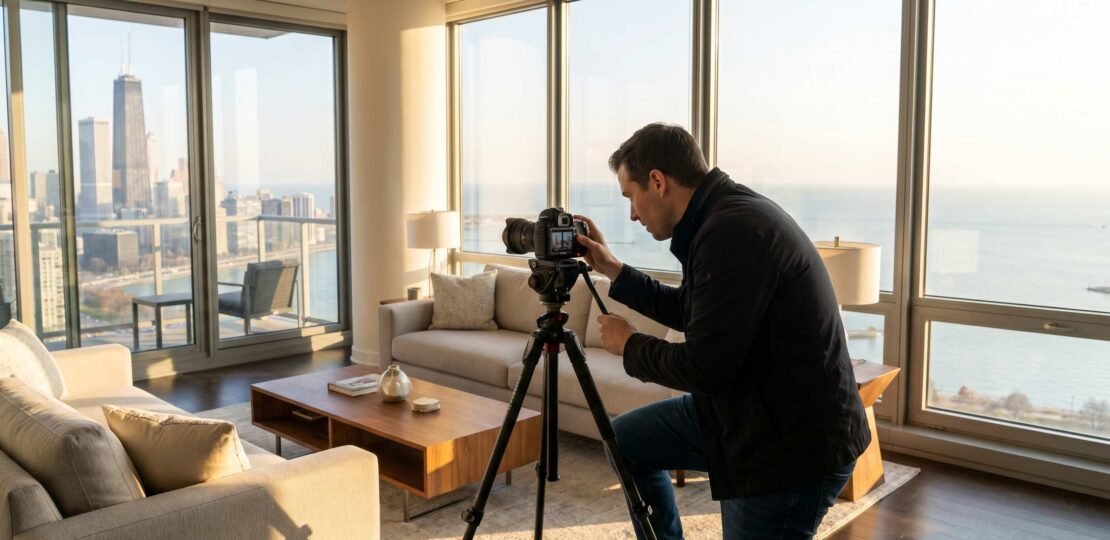
Hiring a real estate photographer in Chicago is harder than it should be. The market is flooded with options ranging from $99 deals on Thumbtack to $1,500 luxury packages, and most agents have no framework for telling them apart. This guide cuts through the noise. We cover what professional photography actually costs in Chicago, how to vet a photographer before you sign anything, and the specific challenges that make this market different from shooting listings in Phoenix or Atlanta. Whether you list condos in River North or single-family homes in Evanston, the right photographer changes how fast your listings move and the price they fetch.
Real estate photography in Chicago typically runs $150 to $400 for standard residential packages, with drone add-ons from $150 to $300. Turnaround is usually 24 to 48 hours. Prices vary by property size, service tier, and neighborhood. Luxury high-rise work in the Gold Coast or Lincoln Park runs higher than standard single-family homes in the suburbs.
Why Chicago’s Real Estate Market Demands Quality Photography
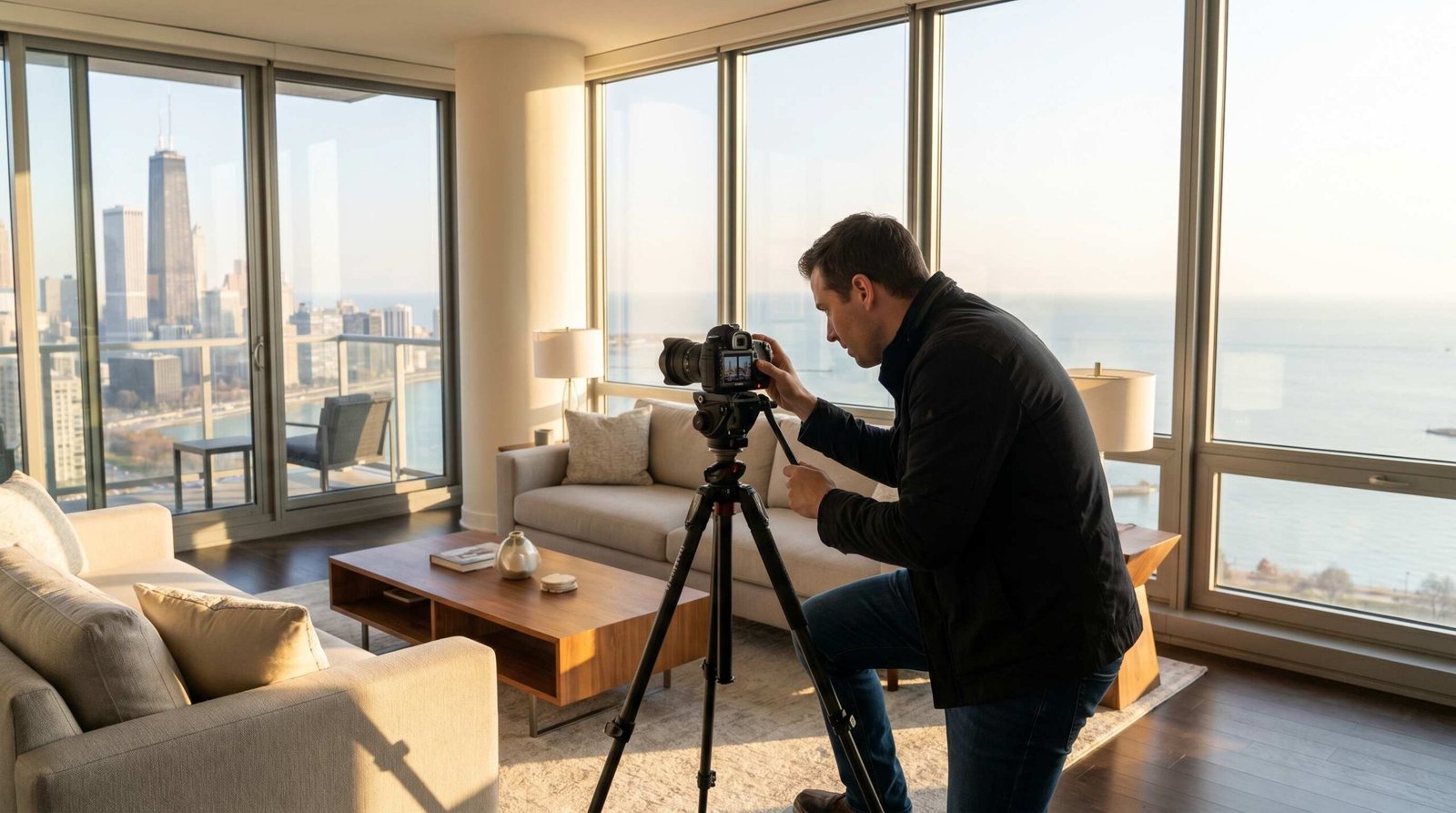
Chicago is the third-largest metro in the country and one of the most visually competitive real estate markets in the Midwest. Buyers scrolling through Zillow or Redfin see hundreds of listings in a single session. Yours has about three seconds to earn a click before they move on.
Over 95% of buyers begin their home search online, according to NAR’s 2025 Profile of Home Buyers. The first photo on your listing is the entire pitch. Listings with professional photography receive significantly more views, more saves, and more in-person showings than listings shot on a phone or with a budget camera. In a city where the average home spent fewer days on market than the national average through much of 2025, photography is not a nice-to-have. It is the difference between a listing that gets traction in the first 72 hours and one that sits.
Chicago’s MLS is crowded. On any given week, agents compete against thousands of active listings across the city and suburbs. The properties that stand out share three traits: strong first photo, consistent exposure across every interior shot, and a thoughtful selection that tells a story rather than just documenting rooms. Phone shots cannot do this. Even a great phone camera fails at the wide-angle interior work that makes a 900 square foot condo look livable and a 4,000 square foot home feel grand.
Pricing pressure adds urgency. Chicago has experienced rising inventory in several neighborhoods, particularly in the condo segment. When buyers have options, they choose based on what they see first. Sellers who invest in better photography see returns that dwarf the cost of the shoot.
Real Estate Photography Pricing in Chicago
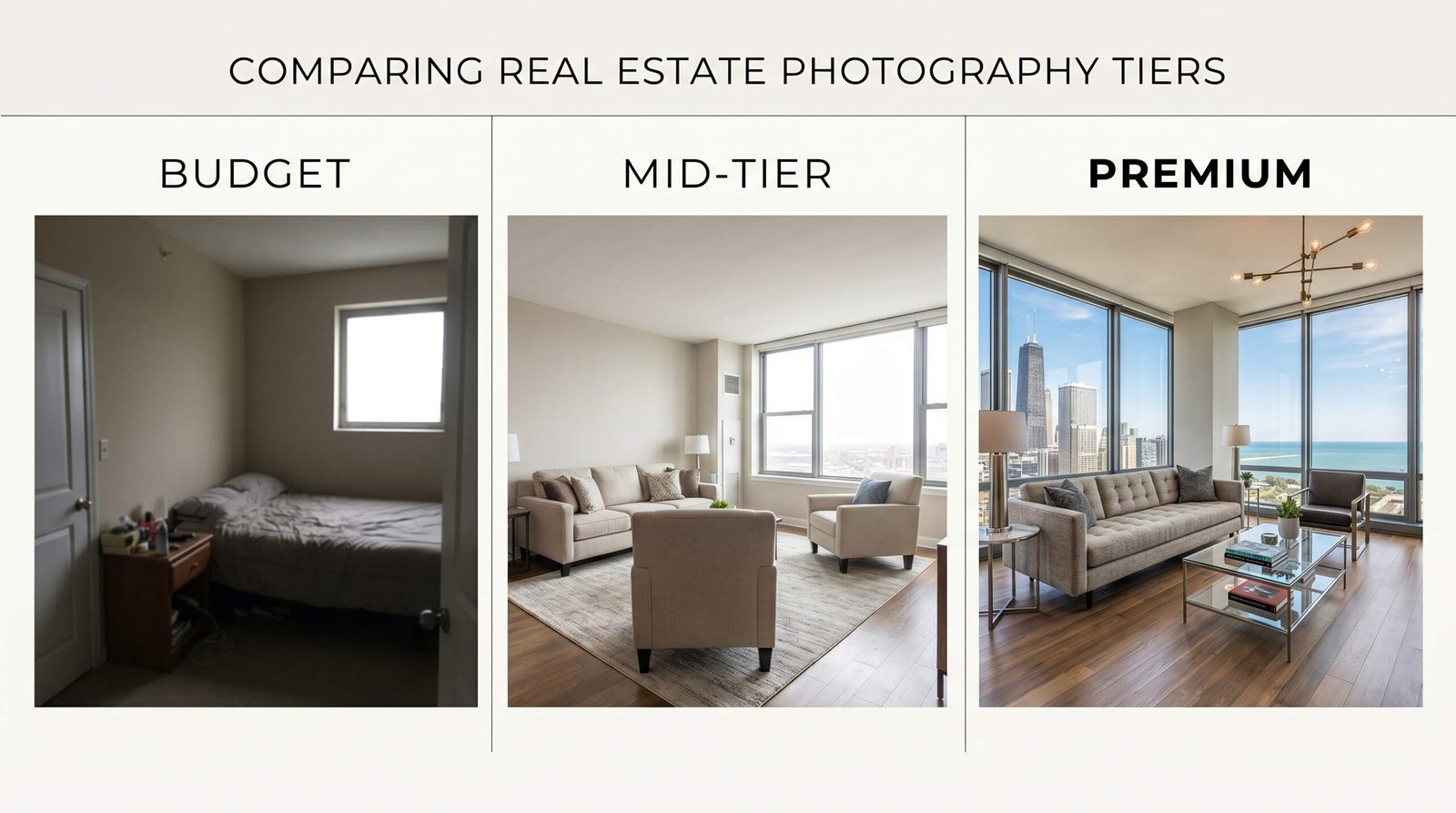
Chicago photography pricing falls into three clear tiers. Each tier targets a different agent and a different property type. Knowing which one fits your listing prevents you from overpaying for a starter condo or underpaying for a luxury sale.
| Tier | Price Range | Typical Turnaround | What’s Included | Best For |
|---|---|---|---|---|
| Budget/Entry | $125 to $175 | 48 to 72 hours | 15 to 25 photos, basic editing, MLS-ready files, limited revisions | Sub-$300K condos, rentals, quick-turn listings under 1,200 sq ft |
| Mid-Tier | $175 to $299 | 24 to 48 hours | 25 to 40 photos, advanced HDR or flambient editing, sky replacement, twilight upsell available, one round of revisions | $300K to $800K single-family homes, mid-range condos in Wicker Park, Logan Square, Bucktown |
| Premium | $300 to $500+ | 24 hours | 40+ photos, full flambient processing, twilight or golden hour included, drone, video walkthrough optional, multiple revisions | Luxury listings in Gold Coast, Streeterville, Lincoln Park, North Shore suburbs, properties over $1M |
Factors that push pricing up:
- Square footage. Most photographers charge tiered pricing based on home size. A 1,000 square foot condo costs less than a 4,500 square foot single-family. Expect $25 to $75 per additional 500 square feet beyond a base tier.
- Add-ons. Drone photography, Matterport 3D tours, floor plans, video walkthroughs, and virtual staging each add cost. A loaded package can double your base price fast.
- Neighborhood premiums. Photographers charge more for shoots that require navigating downtown parking, high-rise building access, or scheduled common-area shoots in luxury buildings. Streeterville and the Loop frequently carry an access surcharge.
- Same-day delivery fees. Need files by 6 PM for a next-morning MLS launch? Expect $75 to $200 in rush fees.
- Twilight and golden hour scheduling. These shoots often add $100 to $250 because they require a separate evening visit or extended on-site time.
- Weekend and holiday surcharges. Saturday is the busiest day of the week. Some photographers charge 10 to 25% more for Saturday slots during the spring rush.
What to Include in a Chicago Photography Package
Not every listing needs every service. A 700 square foot studio in River North does not need a drone. A $2M lakefront home does. Use this checklist to build a package that matches the property and the buyer.
| Service | Need It? | What It Adds | Typical Add-On Cost |
|---|---|---|---|
| Standard photography | Always | Wide-angle interior and exterior shots, properly exposed and color-corrected | Included in base |
| Twilight or golden hour shots | Luxury listings, exterior-heavy properties, downtown high-rises with skyline views | Dramatic exterior photos that significantly outperform daytime equivalents online. See our guide on twilight real estate photography. | $100 to $250 |
| Drone or aerial | Lots over 0.25 acres, lakefront properties, suburban single-family, properties with notable surroundings | Context, lot size visualization, neighborhood appeal, roofline coverage | $150 to $300 |
| Matterport 3D tour | Luxury listings, out-of-town buyer markets, unique floor plans | Self-guided virtual walkthrough, qualifies buyers before in-person showings | $200 to $500 |
| Floor plans | Most listings benefit, particularly homes with complex layouts | Buyer confidence, fewer wasted showings, helps with appraisals | $75 to $200 |
| Virtual staging | Vacant properties, oddly shaped rooms | Furnished look without physical staging cost, helps buyers visualize | $30 to $75 per image |
| Property video or walkthrough | Luxury listings, social-first listing strategies, high-end suburban homes | Social-ready content, longer engagement, stronger emotional appeal | $250 to $800 |
The biggest mistake agents make with packages is over-buying for the price point. A starter condo in Logan Square does not need a $400 drone shoot. The second biggest mistake is under-buying for luxury. A $1.5M home in Lincoln Park without twilight shots and drone footage is leaving money and showings on the table.
Chicago Neighborhood Guide: Photography Needs by District
Chicago is not one market. It is dozens of micro-markets, and each one asks something different from a photographer. A shoot that nails a Gold Coast penthouse would waste money on a Bridgeport two-flat, and a fast budget turnaround that suits Pilsen would sink a Winnetka estate listing. Here is how photography needs shift by district, so you can match the package to the property before you spend a dollar.
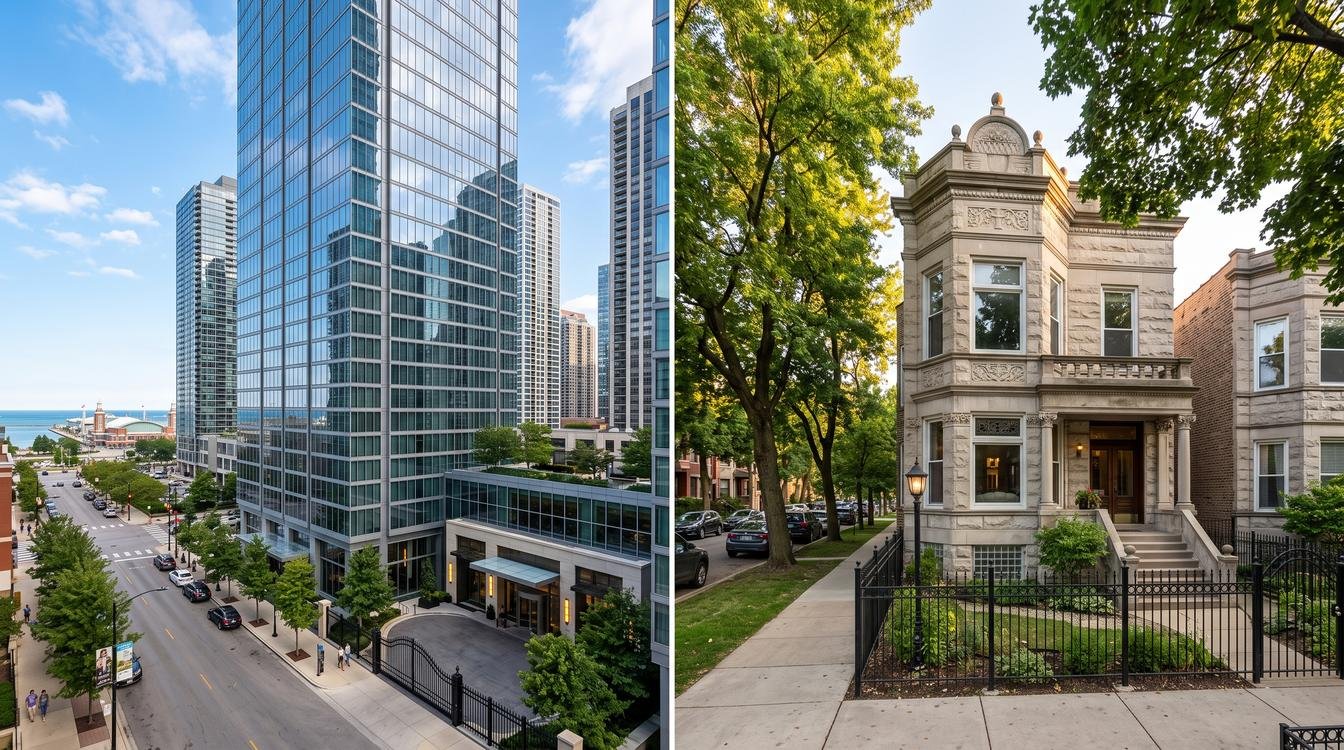
Gold Coast and Streeterville. This is luxury high-rise territory: condos with rooftop decks, skyline views, and $1M-plus price points. Premium packages are mandatory here, and twilight photography is standard rather than an upsell. Expect building access fees and HOA photo restrictions that shape the shoot before it starts. These buildings often require a certificate of insurance (COI) from the photographer before they allow access, so confirm insurance the moment you book.
Lincoln Park and Lakeview. Classic brownstones and greystones dominate, drawing established families in the mid-to-upper market, roughly the $500K to $1.5M range. Drone demand is strong for corner lots and properties near Lincoln Park itself, where green space sells the location. Architecture shots require a wide-angle lens with good lens correction to handle the tight city lots without bowing the vertical lines of these historic facades.
Wicker Park, Bucktown, and Logan Square. Vintage graystones and two-flats with exposed brick and high ceilings define the look here. The hip buyer demographic scrolls Instagram heavily, so social-format vertical crops are worth requesting alongside the standard set. Budget $200 to $350 for most listings in these neighborhoods. Exposed brick and hardwood floors photograph well but need careful lighting to avoid flat, muddy tones that flatten all the character out of the space.
West Loop and River North. Loft conversions, modern luxury condos, and restaurant-adjacent buildings drive this market. Floor-to-ceiling glass units need careful glare control and bracketing to hold both the interior and the view. Expect strong 3D tour demand from tech-sector buyers who want to do a virtual walkthrough before they set foot in the unit.
Pilsen, Bridgeport, and South Shore. The housing stock here is more affordable: older two-flats, bungalows, and courtyard buildings. Budget-tier photography works well, and drone is less critical since lot context matters less than it does up north. Quick-turn delivery, whether 24-hour or same-day, is often valued over premium processing, so put speed first when you vet.
North Shore suburbs (Evanston, Wilmette, Glencoe, Winnetka, Lake Forest). Larger lots, luxury estates, and mature tree canopy set the tone. Drone demand is strong for showing lot size and neighborhood context that a ground shot cannot capture. Premium and twilight photography are standard at this price tier, which runs $800K to $3M and up. Many North Shore listings use full packages that combine drone, twilight, floor plans, and Matterport in a single booking.
Outer Chicagoland suburbs (DuPage, Lake, Will, and McHenry Counties). This is volume suburban work with varied price points, and mid-tier packages are the most common fit. Many photographers based downtown will not travel 30 to 45 minutes out, so use Chicagoland specialists or national platforms like Virtuance or HomeJab that maintain coverage networks across the far suburbs.
| District | Typical Package Tier | Key Add-On |
|---|---|---|
| Gold Coast/Streeterville | Premium ($300-500+) | Twilight + Matterport |
| Lincoln Park/Lakeview | Mid to Premium ($200-400) | Drone |
| Wicker Park/Bucktown/Logan Square | Mid-Tier ($175-350) | Social-format crops |
| West Loop/River North | Premium ($300-500+) | 3D tour |
| Pilsen/Bridgeport/South Shore | Budget to Mid ($125-250) | Fast turnaround |
| North Shore suburbs | Premium ($400-600+) | Full package |
| Outer Chicagoland | Mid-Tier ($175-299) | National platform option |
Photographing Chicago High-Rises and Condos: What Agents Need to Know
Downtown high-rise work is a specialty, not a standard residential shoot with a taller building. The logistics alone can derail a booking if you do not plan for them, and the technical demands weed out most budget photographers. If you list condos in the Loop, River North, Streeterville, or the Gold Coast, walk through these six points before you schedule anything.
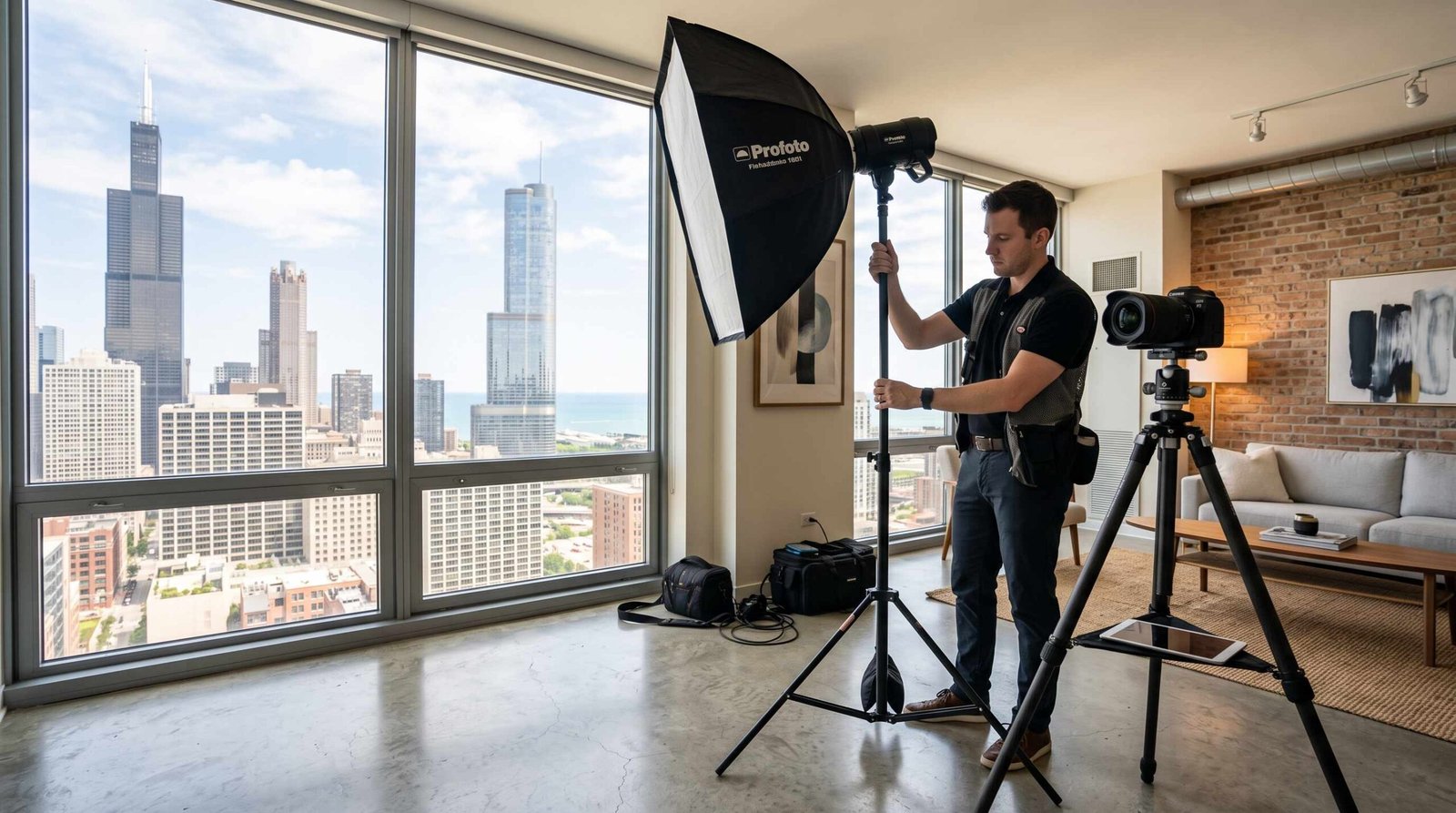
1. Building access procedures. Many luxury downtown buildings require 24 to 48 hours advance notice for vendors. Some require the agent to escort the photographer or submit a certificate of insurance (COI) before anyone gets past the front desk. Book early and confirm building rules at least 3 days before the shoot so a paperwork gap does not cost you the appointment.
2. HOA photo restrictions. Some buildings prohibit photos of common areas, including lobbies, hallways, and rooftop terraces, without board approval. Always clarify scope before booking. Getting approval for lobby or rooftop amenity shots can add significant marketing value, because they help buyers feel the building, not just the unit.
3. Elevator and gear logistics. Professional lighting equipment, meaning light stands, multiple strobes, and reflectors, takes elevator space and requires planning. Schedule the photographer’s arrival during off-peak hours, mid-morning on weekdays rather than Saturday at noon. Allow 15 to 20 minutes of extra arrival time for gear setup and freight elevator coordination.
4. Window exposure mastery. Chicago high-rises are sold largely on the view. A photographer who cannot balance interior exposure with the skyline visible outside, using bracketing, flash, or compositing, is the wrong choice for a high-rise listing. Ask specifically to see high-rise portfolio samples before booking any downtown shoot, and look hard at whether the windows show a crisp skyline or a blown-out white rectangle.
5. Unit size and shooting space. Many downtown condos are 600 to 900 square feet. Wide-angle lenses, typically 16 to 24mm full-frame equivalent, are required to make those rooms read as livable. Ask the photographer what their widest lens is. A photographer with only a kit zoom cannot do this work properly, and the tight rooms will show it.
6. Parking and logistics. Downtown Chicago building access often means no nearby street parking for a photographer hauling equipment. Ask the building whether vendor parking is available, or budget for a nearby garage. Factor this into your overall shoot timeline so the photographer is not burning a paid session circling the block.
| High-Rise Shoot Checklist: Before Booking | |
|---|---|
| Item | Action Required |
| Building COI requirement | Ask agent manager if building requires photographer’s COI |
| Advance notice window | Confirm with building management (24, 48, or 72 hours) |
| Common area photo approval | Request HOA board permission if lobby/amenity shots planned |
| Elevator reservation | Ask building if service elevator booking is needed |
| Parking for photographer | Confirm building vendor parking or budget for garage |
| HOA photo restrictions | Review building rules before finalizing shoot scope |
How to Find and Vet a Chicago Real Estate Photographer
The best Chicago real estate photographers are rarely the ones at the top of Google. They are booked solid through referrals and word of mouth. Here is where to actually find them.
Where to look
- Local MLS referrals. Ask your office’s top producers who they use. Top agents have already filtered the market.
- Chicago real estate Facebook groups. Groups like Chicago Realtors and neighborhood-specific groups are full of agent reviews. Search “photographer” in the group to see recent threads.
- Local photography associations. The Chicago Association of REALTORS maintains a directory of vetted commercial photographers, many of whom shoot architecture and real estate. It is a strong starting point if you want professionals with formal training and liability insurance.
- Instagram hashtags. #ChicagoRealEstatePhotographer and #ChicagoRealEstate surface working photographers along with examples of their current work.
- Builder and architect referrals. If you list new construction or rehabs, the contractors and architects often know who the developers are using.
Portfolio review checklist
Look at consistency, not just the highlight reel. A photographer’s best shot is easy. Their average shot tells you what your listing will actually look like.
- Does the lighting look consistent room to room? Hot spots, blown windows, and orange tungsten light in kitchens mean inconsistent exposure technique.
- Are vertical lines actually vertical? Slanted walls indicate poor lens correction or a photographer not using a tripod.
- Do windows show what is outside? Good photographers expose for both interior and exterior. Blown-white windows are a sign of single-exposure shooting without flash or HDR work.
- Are color tones natural? Skin-tone whites, accurate wood floors, no green or blue color cast. Bad white balance is the fastest way to tell a budget photographer from a pro.
- Do they show work across property types? A photographer who only shows luxury homes may struggle with a tight condo. Look for range.
- Is the editing consistent across the portfolio? Wildly different looks suggest the photographer hands editing off to different freelancers, which causes inconsistency in your final deliverables.
Questions about their process
The questions you ask before booking separate professionals from people with a camera. Walk through these before you sign anything. For deeper context on what good work actually looks like, see our guide to real estate photography best practices.
- Do you use flash, ambient light, or both? Pros typically use a flambient technique, blending ambient and flash exposures for clean, true-to-life interiors.
- Do you bracket for HDR? Bracketing captures multiple exposures and merges them for balanced light. It is the standard for window-heavy interiors.
- What is your editing style? Heavy HDR with halos looks dated. Modern editing is clean, neutral, and natural.
- Who edits the photos? In-house or outsourced? Outsourced is fine if quality stays consistent. Ask to see recent listings edited by the same team.
- Do you carry liability insurance? Required for many luxury buildings and any commercial property.
Chicago-Specific Photography Challenges
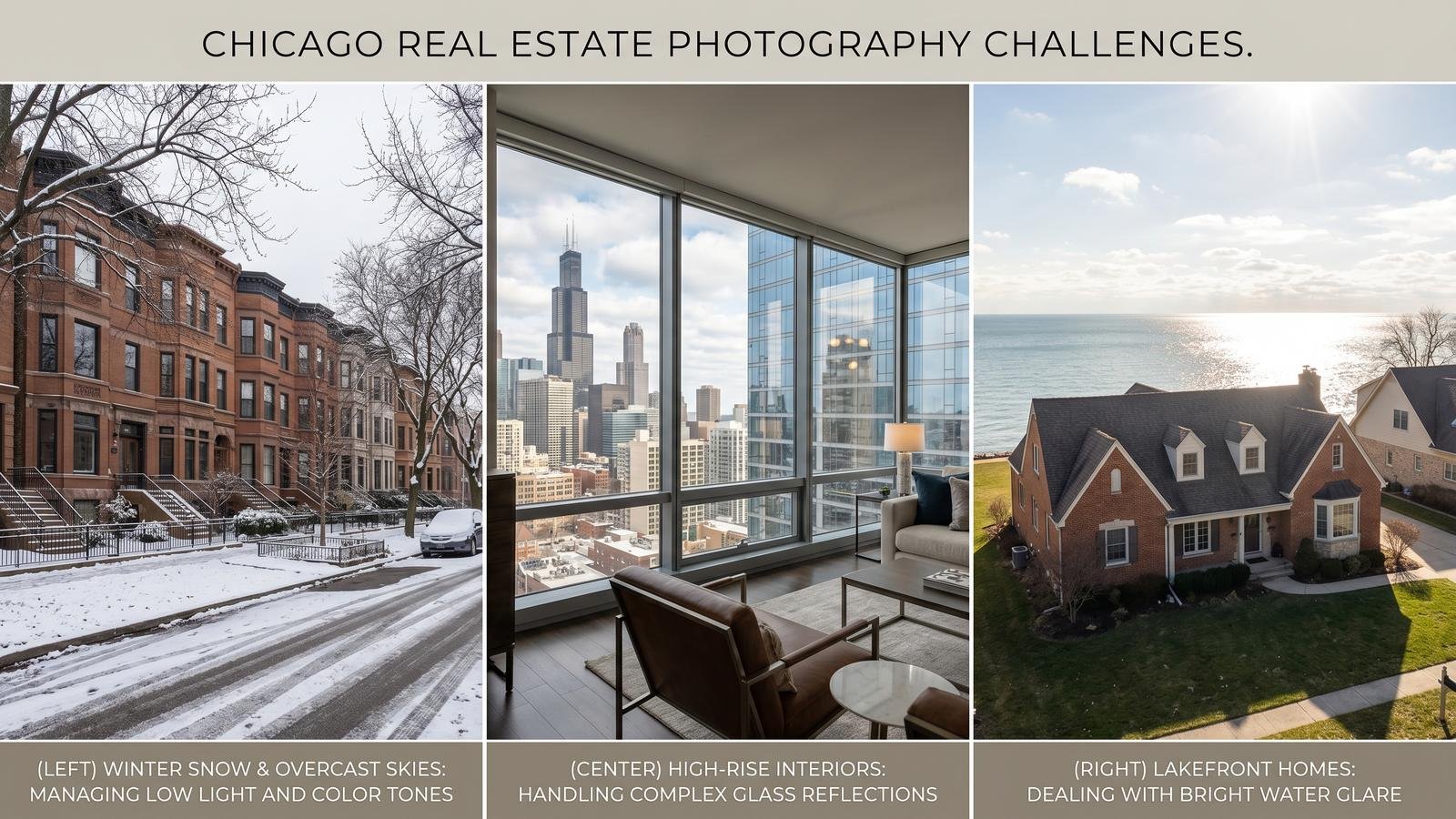
Chicago is one of the harder markets in the country to photograph well. The weather, the architecture, and the geography all create problems that photographers in milder climates never face.
Winter shoots
From November through March, Chicago skies are gray. Daylight hours shrink. Snow piles on lawns and driveways. A budget photographer shows up and shoots what is there: dim interiors, flat exteriors, brown grass under gray sky. A professional adjusts the approach.
Sky replacement has become standard. Tools like Photoshop’s sky replacement and dedicated software let editors swap a flat gray sky for a clean blue one without ruining the rest of the image. Done well, it looks natural. Done poorly, it looks fake. Ask to see winter portfolio examples to judge the quality of their sky replacements before you book a January shoot.
Artificial lighting becomes critical in winter. Interior shots that look bright and welcoming in July need careful flash work in February. A photographer who relies only on natural light through south-facing windows will deliver dim, flat winter shots. Pros bring multiple flashes, light stands, and modifiers to compensate. Dialing in consistent exposure across a dark winter interior comes down to disciplined technique, and our guide to real estate photography camera settings breaks down the aperture and ISO choices that keep those shots clean.
Scheduling around golden hour matters more in winter because there is less of it. Plan exterior shots for the narrow window before sunset, and book the photographer with enough lead time to time the visit precisely.
Architecture diversity
Chicago has more architectural variety than almost any other US city. A photographer who shoots a Streeterville high-rise in the morning and a Wicker Park graystone in the afternoon needs a different approach for each.
Downtown high-rises present specific problems. Glass walls reflect the city back at the camera. Shooting through floor-to-ceiling windows means managing reflections, balancing the interior light against bright skyline exteriors, and often working in tight spaces with no room to back up. Polarizers, careful angle selection, and bracketed exposures are all part of the toolkit.
Lincoln Park brownstones, Logan Square two-flats, and Bucktown workers cottages each have their own challenges. Tall narrow staircases, period details that need to be highlighted without overpowering modern updates, and dark hallways that need fill lighting.
Suburban single-family homes in Evanston, Oak Park, La Grange, and the North Shore tend to be more straightforward to photograph but demand strong drone work to show lot size and tree-lined streets. Having the right equipment for every scenario separates working pros from hobbyists.
Lakefront properties
Lake Michigan is a feature you want to highlight, but it creates real problems for photographers. Harsh glare off the water during midday makes it difficult to balance interior shots that include the lake view. Strong reflections in floor-to-ceiling windows can produce hot spots and color casts.
The fix is timing and technique. Shoot east-facing lakefront interiors early morning when the sun is low and the lake reflects warm light. Shoot west-facing exteriors in late afternoon. Polarizing filters reduce reflections off the water. Multiple exposures captured at the same focal length can be blended to retain both the lake view and the interior detail.
Spring real estate rush
Chicago’s listing season kicks off in February and peaks through April and May. Photographers book up fast. By mid-March, the best in the city are scheduled two to three weeks out. If you know a listing is coming, book the shoot the same week you sign the listing agreement. Waiting until the seller is “ready” costs you days you cannot recover.
Drone Photography in Chicago: What Agents Need to Know
Drone footage sells lot size, lakefront proximity, and neighborhood context in a way no ground shot can. But Chicago has one of the most complicated airspace environments in the country, and a photographer who does not understand it can leave you with no aerials on shoot day and no explanation. Here is what actually governs a Chicago drone shoot.
1. Complex airspace. Chicago is one of the most complex drone airspace environments in the US. O’Hare International Airport (ORD) sits inside Class B airspace covering much of the northwest suburbs and portions of the city itself. Midway Airport (MDW) covers a significant radius of the southwest side under Class D airspace. Any drone flight in these zones requires LAANC authorization under FAA Part 107 regulations.
2. How LAANC works. LAANC (Low Altitude Authorization and Notification Capability) lets certified drone pilots get near-real-time airspace authorization through apps like Aloft or AirMap. This adds a pre-shoot step that photographers based outside Illinois may not be fully familiar with. Always confirm your photographer holds an active FAA Part 107 Remote Pilot Certificate and understands Chicago’s specific airspace before booking a drone shoot.
3. Lakefront and downtown considerations. Some lakefront areas and the downtown core fall under temporary or permanent flight restrictions depending on events. Ask your photographer to pull a current NOTAM (Notice to Air Missions) check within 24 hours of the shoot. A waterfront shoot on a day with a lakefront festival or large downtown event may be unflyable, and you want to know that before you schedule the seller, not after.
4. When drone is not an option. For properties in dense downtown sectors where airspace authorization is not achievable quickly, discuss alternatives. Pole photography from the ground, rooftop access shots, or high-floor window photography that simulates an aerial perspective can all fill the gap when a true drone flight is off the table.
5. Where drone adds the most value in Chicago. Lakefront properties benefit most, where lake context and shoreline proximity sell the home. So do North Shore estate lots, where lot size, tree canopy, and neighborhood character matter, along with properties adjacent to Lincoln Park or the Forest Preserves, and any listing where neighborhood context sells the home as much as the interior does.
| Location | Airspace | LAANC Required? |
|---|---|---|
| O’Hare vicinity (northwest suburbs) | Class B | Yes |
| Midway vicinity (southwest Chicago) | Class D | Yes |
| Downtown Chicago core | Class B overlap | Yes – plan 24-48 hrs ahead |
| North Shore suburbs | Class E to uncontrolled | Check NOTAM |
| DuPage/Lake/Will Counties | Mixed | Usually not required; check NOTAM |
Red Flags When Hiring a Chicago Real Estate Photographer
Bad photographers are easier to spot than agents realize. The signs are usually visible before the first email exchange ends. Watch for these.
- No portfolio on the website. Or worse, a portfolio that links to stock photos. Any working photographer has a current, organized portfolio. If they cannot show you 20 to 50 recent shoots, walk.
- Will not provide references. Pros have repeat clients who will vouch for them. If they cannot name three agents you can call, that tells you everything.
- Pricing seems too low for the scope. A $99 shoot that includes 40 photos, drone, twilight, and floor plans is either impossible or means someone is cutting corners on time, editing, or equipment. The math has to add up.
- No mention of file format or delivery method. Pros deliver high-resolution JPEGs sized for MLS plus web-optimized versions, usually through a gallery link like Dropbox or a custom portal. If they are emailing raw files, something is off.
- Does not own proper lighting. A photographer who shoots only with natural light cannot handle Chicago interiors in winter. Ask what gear they bring. The answer should include multiple flashes, light stands, and modifiers.
- Edits photos on-site rather than in post. Editing in the field, or in the car between shoots, is a sign of a rushed workflow. Real editing happens on a calibrated monitor in a controlled environment.
- No insurance or contract. Working without a written contract is a liability for both sides. If they cannot send you a basic agreement covering deliverables, timing, payment, and usage rights, find someone else.
Questions to Ask Before Booking
A short pre-booking call answers most of what you need to know. Cover these eight questions every time.
- What is your turnaround time? Standard is 24 to 48 hours. Anything longer is too slow for Chicago’s market pace.
- Do you handle virtual staging or sky replacement? If yes, ask to see examples. If they outsource, ask who and what the timeline is.
- What happens if the weather is bad day-of? A pro has a clear reschedule policy. Some shoot interiors regardless and reschedule only exteriors. Get the policy in writing.
- What file formats do you deliver? Expect MLS-sized JPEGs and web-optimized versions. Some photographers also deliver social-formatted vertical crops.
- How many photos will I receive? Standard residential delivers 25 to 40 final images. Luxury can be 50+.
- Are revisions included? Most pros include one round of minor revisions. Major re-edits beyond that usually cost extra.
- Do you carry liability insurance? Required for many downtown buildings. Confirm before booking high-rise shoots.
- What is your cancellation policy? Standard is 24 to 48 hours notice. Some require a deposit that becomes non-refundable past a certain point.
Why Some Chicago Agents Hire Out-of-Town Photographers
National platforms like Virtuance, HomeJab, and Aryeo have entered the Chicago market over the last several years. They operate by recruiting local photographers and managing booking, editing, and delivery through a central platform. For agents, they offer predictable pricing, fast scheduling, and consistent deliverables.
Pros of national platforms
- Fast booking, often within 24 to 48 hours.
- Standardized pricing across markets. Easier to budget if you list in multiple cities.
- Consistent editing standards because post-processing happens centrally.
- Customer support if a shoot goes sideways.
- Integrated tools for floor plans, virtual staging, and Matterport tours.
Cons of national platforms
- The photographer on the ground is often less experienced than the city’s top independents. Platforms recruit photographers who will accept their rates, which are lower than what experienced locals charge.
- Less flexibility for unusual properties, complex schedules, or special requests.
- You rarely build a long-term relationship with the same photographer.
- Quality varies shoot to shoot depending on who shows up.
When does a national platform make sense?
If you list moderate-priced properties in volume and need fast, predictable delivery, national platforms work well. If you list luxury or trophy properties where presentation drives the sale price, hire local. For high-stakes shoots in Lincoln Park, Streeterville, or the North Shore, a top Chicago independent will outperform a platform photographer. For deeper context on what to look for at the top end of the market, see our guide to luxury real estate photography.
FAQ
How much does real estate photography cost in Chicago?
Standard residential photography in Chicago costs $150 to $400 per shoot. Luxury packages with drone, twilight, video, and Matterport can reach $800 to $1,500+. Add-ons including drone ($150 to $300), Matterport ($200 to $500), and virtual staging ($30 to $75 per image) add to the base price.
How far in advance should I book a real estate photographer in Chicago?
Book one to two weeks ahead in the off-season (November to January), and two to three weeks ahead during the spring rush (February to May). The best photographers fill their calendars first. Same-week booking is sometimes possible but usually means accepting a lesser photographer or paying a rush fee.
What is the best time of day for real estate photography in Chicago?
Mid-morning to early afternoon for interiors. Late afternoon or twilight for exteriors. South-facing rooms photograph best when the sun is at an angle rather than directly overhead. Lakefront properties with east-facing views shoot best in early morning. West-facing exteriors are strongest at golden hour.
Do I need drone photography for every listing in Chicago?
No. Drones add the most value for properties on larger lots, lakefront homes, suburban single-family with notable yards, and listings where surrounding context (parks, lake access, school districts) matters. For most condos and townhomes inside the city, drone is unnecessary and adds cost without proportional return.
How long does a real estate photography shoot take?
A standard residential shoot runs 60 to 120 minutes on site. Luxury shoots with drone, twilight, and video can take three to five hours, sometimes split across two visits. Make sure the home is fully ready when the photographer arrives. Time spent waiting on tidying or staging eats into editing budget.
Should I stage the home before the photographer arrives?
Yes. Photography captures whatever is there. Decluttered surfaces, made beds, retracted blinds, lights on, and removed personal items make a measurable difference in final image quality. Send the seller a pre-shoot checklist 48 hours ahead. Professional photographers will move small items but should not be cleaning or staging.
What is the difference between virtual staging and traditional staging for photos?
Traditional staging puts real furniture in the home. It costs $1,500 to $5,000+ per month depending on home size and stager. Virtual staging digitally adds furniture to photographs of empty rooms for $30 to $75 per image. Virtual staging is faster and cheaper but less effective for in-person showings. Many agents use virtual staging for online listings and rely on the empty home for showings.
Is 3D tour photography worth it for Chicago listings?
Yes, particularly for high-rises, luxury listings, and properties targeting out-of-state buyers. Chicago attracts a significant number of relocation buyers from New York, Los Angeles, and Sun Belt markets. A self-guided Matterport or similar 3D tour lets remote buyers pre-qualify the property before booking a flight. The investment ranges from $200 to $500 and is standard at the premium tier. See our full guide to 3D real estate photography for equipment and platform options.
What camera settings do Chicago real estate photographers typically use?
Most pros shoot at f/7.1 to f/9 for maximum depth of field, ISO 100 to 400 to minimize noise, and shutter speeds that vary based on ambient light. Chicago’s dramatic seasonal light swings, winter gray versus summer bright, make consistent exposure discipline more important than in sunnier markets. For bracketed HDR or flambient shooting, three to five exposures at one-stop intervals is standard. See our guide to real estate photography camera settings for the full breakdown.
The right photographer makes the difference between a listing that moves and one that sits. Take the time to vet, ask the right questions, and match the package to the property. If you are on the other side of the lens and curious about the business itself, see our guide to how to become a real estate photographer.
RELATED POSTS
View all

Real Estate Photographer Seattle: The Complete Agent’s Hiring Guide (2026)
October 1, 2026 | by Ian
Real Estate Photographer San Diego: The Complete Hiring Guide (2026)
June 4, 2026 | by Ian
Real Estate Photography Camera Settings: The Complete 2026 Guide
June 5, 2026 | by Ian